






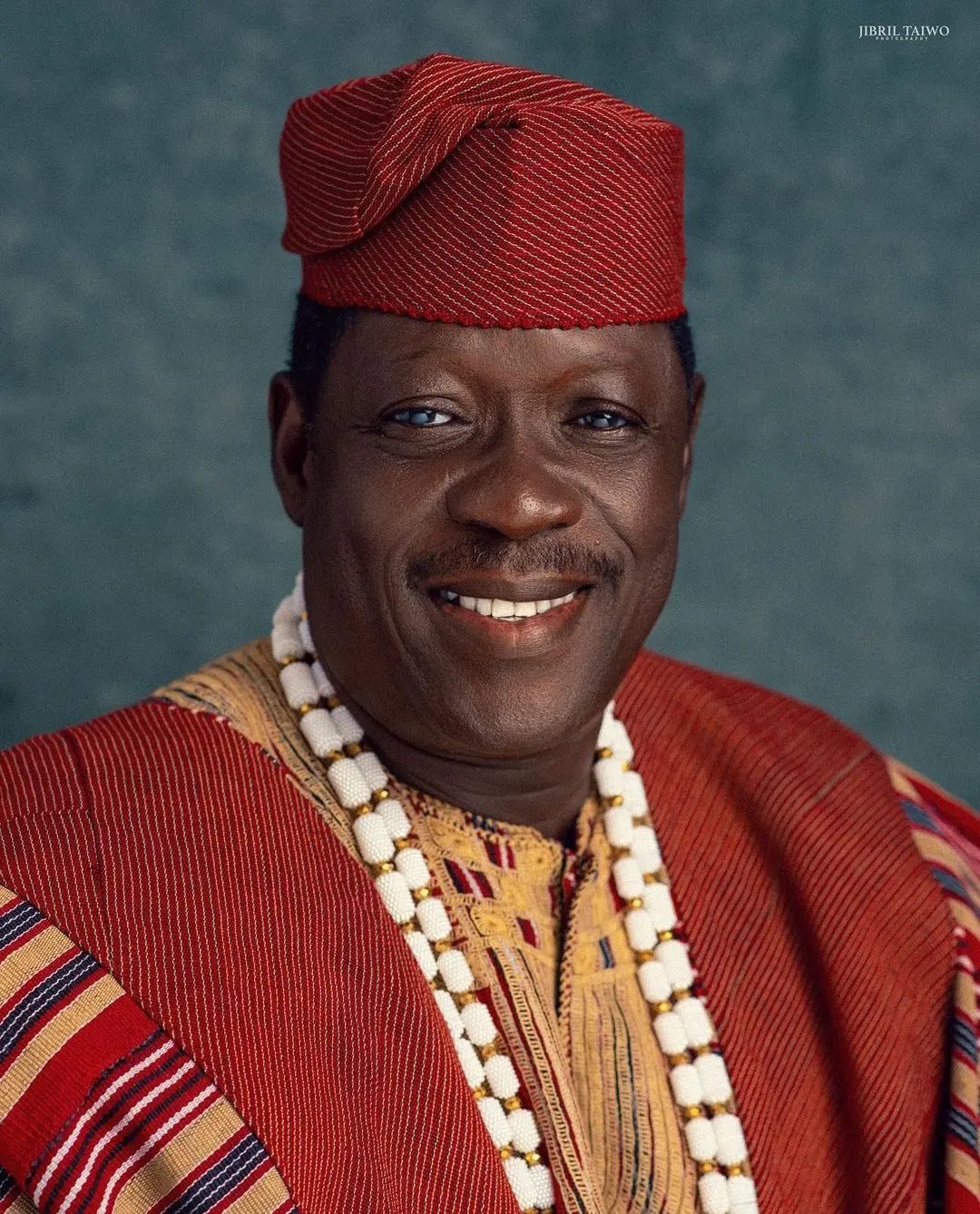
Taiwo Hassan Ogogo is one of the most recognizable veteran actors to emerge from Nigeria’s Yoruba-language theatre and film tradition. Born on October 31, 1959, in Ilaro, Ogun State, Nigeria, he built a remarkable career that moved from automobile engineering and stage performance to becoming an actor, producer, director and one of the enduring faces of Yoruba cinema.
Known professionally as Ogogo, Taiwo Hassan has spent decades turning traditional Yoruba storytelling, moral lessons, family conflicts, historical narratives and social realities into memorable screen performances. His career has also crossed generations: he was already an established name when many of today’s popular Nollywood performers were still children, yet he continued appearing in major contemporary productions such as Aníkúlápó and Aníkúlápó: Rise of the Spectre.
As of August 2026, Taiwo Hassan is 66 years old and remains associated with acting, filmmaking, cultural preservation and business interests. His story is particularly compelling because he did not begin as a full-time movie star. He first trained in automobile technology and worked for the Lagos State Water Corporation before eventually committing himself completely to acting.
His journey illustrates one of the defining stories of Nigerian entertainment: the transition from traditional travelling theatre and stage performance into the modern home-video and streaming era.
Quick Facts About Taiwo Hassan Ogogo
| Personal Information | Details |
|---|---|
| Full name | Taiwo Hassan |
| Also known as | Ogogo, Alhaji Taiwo Hassan |
| Date of birth | October 31, 1959 |
| Age in 2026 | 66 |
| Place of birth | Ilaro, Ogun State, Nigeria |
| Nationality | Nigerian |
| Profession | Actor, producer, director, filmmaker |
| Main industry | Nigerian film industry, particularly Yoruba-language cinema |
| Years active | Since the early 1980s |
| Technical training | Automobile/mechanical training |
| Former employer | Lagos State Water Corporation |
| Major breakthrough | Owo Blow |
| Major award | City People Movie Lifetime Achievement Award |
| Major modern film | Aníkúlápó |
| Traditional title | Otun Mayegun of Ilaro-Yewa |
| Business interest | Real estate |
| Real-estate brand | Ogogo Royal Estate |
| Religion | Islam |
| Hometown | Ilaro, Ogun State |
| Known for | Yoruba-language films, stage acting, production and cultural storytelling |
The exact spelling and form of some details about Taiwo Hassan’s birth name, education and family history vary across older publications. Where reliable sources disagree, this biography identifies the discrepancy rather than presenting one version as unquestionably established.
Early Life and Family Background

Taiwo Hassan was born in Ilaro, a historic town in present-day Yewa South Local Government Area of Ogun State. His upbringing connected him closely with Yoruba culture, language and traditional forms of storytelling, elements that would later become central to his identity as an actor.
One of the most distinctive aspects of his family background is its association with twins. Hassan has repeatedly spoken about the unusually high occurrence of twins in his family. In a 2011 interview, he explained that his grandfather was a twin, his father was also a twin, and his mother gave birth to twins on several occasions.
More recently, in July 2026, Hassan reportedly discussed this family history again during an appearance on Stirring Stories by Simisola. According to the report, he said his mother had four sets of twins and that he was the only surviving child from those twin births.
Some older biographies describe him as having a twin brother who died young, while other accounts have supplied different names or descriptions. Because these details have not been consistently documented across authoritative sources, the safest conclusion is that Hassan comes from a family with an unusually strong history of twins and that he experienced significant sibling loss.
That family history appears to have influenced the way he understood identity and heritage. Even his professional name, Ogogo, is connected to his family’s Yoruba praise tradition rather than being an arbitrary entertainment nickname.
The Meaning Behind the Name Ogogo
For many Nigerian movie audiences, the name Ogogo is almost as recognizable as Taiwo Hassan himself.
But the name did not originate simply as a marketing invention. Hassan has explained that Ogogo comes from his family oriki, the Yoruba praise-poetry tradition used to identify family lineage and heritage.
In a 2019 interview with City People, he explained that his father’s family oriki included the expression associated with “Ogogo,” and that the name therefore had a deeper cultural meaning within his family.
His daughter Olawunmi also explained in an interview that Ogogo was connected to the family’s compound name and was not merely a stage name invented for the entertainment industry.
This is important when understanding Taiwo Hassan’s career.
The name Ogogo became a brand, but it remained connected to his Yoruba identity. Rather than abandoning his cultural background in order to become a mainstream Nigerian celebrity, he turned his heritage into one of the strongest parts of his professional identity.
Education and the Difficult Road to a Career
Taiwo Hassan’s educational journey was not straightforward.
Several biographies and interviews agree that he attended Christ Church School in Ilaro for his early education before continuing his schooling in Lagos. Sources variously identify his secondary school as Gaskiya College or Gasikia College, while an older interview gives another account of his schooling.
There is stronger agreement that financial difficulties prevented him from completing the conventional academic path. Instead of allowing the interruption to end his ambitions, Hassan pursued technical training.
He eventually trained in automobile mechanics/engineering at a technical institution in Lagos. The Guardian reported that he studied Automobile Engineering at the Federal Technical College, Akoka, in Yaba, while other accounts identify the institution more generally as Yaba Technical College or Yaba Technical School.
The differences in institutional naming may partly reflect changes in the way the school was described over the years. What is consistently supported is that Hassan received technical training in automobile-related work and subsequently built a career around that skill before becoming a full-time actor.
This period is crucial because it demonstrates that Taiwo Hassan did not enter the entertainment industry from a privileged celebrity background. His early working life was connected to a practical profession.
Working at the Lagos State Water Corporation
After completing his technical training, Hassan found employment connected to the Lagos State Water Corporation.
Accounts differ slightly on the exact number of years he worked there. Some sources describe approximately 13 years, while others give a longer period. The Guardian and several other profiles consistently identify him as a former employee of the Lagos State Water Corporation.
The job provided stability, but acting was already pulling him in another direction.
Rather than immediately abandoning his employment, Hassan developed his theatrical career alongside his professional work. This dual existence—worker by day and performer by passion—became an important stage in his development.
Eventually, the pull of theatre became stronger than the security of his government-related employment.
In 1994, he left the water corporation to concentrate fully on acting.
That decision represented one of the most important turning points in his life.
How Taiwo Hassan Ogogo Entered Acting
Hassan’s involvement with theatre predates his full-time career as a screen actor.
In later interviews, he traced his theatrical journey back to the 1970s. In a 2024 City People interview, he said his journey in theatre began around 1974, although his more formal performing career developed in the early 1980s under the mentorship of Awo Ademola Fabunmi.
Other interviews place his professional acting beginning around 1981 or 1982.
These dates should not necessarily be viewed as contradictory. A person can participate in theatre in one period, begin formal apprenticeship in another and only later become a professional full-time actor.
For Hassan, this gradual development was significant.
He was not simply discovered by a film producer and transformed overnight into a celebrity. He came through the theatre system, where actors were expected to learn performance, dialogue, character interpretation, audience interaction and Yoruba cultural expression.
He reportedly began by performing roles connected to traditional praise singing and royal eulogies. In his own description, one of his early functions was as an “Akide Oba,” someone who eulogizes a king.
That experience helped him develop something that would later become one of his trademarks: command of Yoruba language and cultural expression.
Mentorship Under Awo Ademola Fabunmi
One of the most important figures in Taiwo Hassan’s early acting development was Awo Ademola Fabunmi.
Hassan has credited Fabunmi as a major influence and mentor during the formative stage of his acting career. Older interviews describe Fabunmi as an Ifa priest and theatre practitioner under whose tutelage Hassan developed his craft.
This apprenticeship was important because the Yoruba theatre tradition was not primarily built around formal film schools. Much of the knowledge was transmitted through observation, participation, rehearsal and mentorship.
Young performers learned by working alongside experienced actors.
Hassan’s early exposure to this system gave him a foundation that would remain visible throughout his career. His performances often retained the rhythm and theatricality of Yoruba stage storytelling even after he became a major film actor.
From Stage Theatre to Nigerian Cinema
Taiwo Hassan came of age professionally during a period when Nigerian entertainment was undergoing a major transformation.
The Yoruba travelling-theatre tradition had already produced generations of influential performers. But the arrival and expansion of home-video production created new opportunities for those theatre practitioners.
Instead of performing only before live audiences, actors could now reach households across Nigeria and eventually international audiences.
Hassan was part of that transition.
He has described himself as one of the pioneers of modern video storytelling in Nigeria. His career therefore belongs to an important bridge between traditional Yoruba theatre and modern Nollywood.
This helps explain why his acting style has remained distinctive.
His performances are often rooted in theatrical presence: strong dialogue, expressive facial reactions, controlled movement, Yoruba idioms and the ability to communicate moral or emotional ideas directly to the audience.
Becoming a Producer and Filmmaker
Acting was only one part of Taiwo Hassan’s ambitions.
He gradually moved into production and filmmaking, taking greater control over the stories he wanted to tell.
In a 2024 interview, he said he began producing his own work in the early 1990s, with 1993 mentioned as an important year in his production journey.
This transition was strategically important.
An actor depends on producers and directors for roles. A producer, however, can participate in deciding what stories are made, which actors are selected and how cultural themes are presented.
For Hassan, producing provided a way to preserve his artistic independence.
His work has included acting, writing, producing and directing across different stages of his career. His filmography includes titles from the 1990s through the streaming era, demonstrating how long he has remained active despite dramatic changes in Nigerian filmmaking.
The Breakthrough of Owo Blow
The defining breakthrough in Taiwo Hassan’s career came with Owo Blow.
The film, directed by Tade Ogidan, helped expose Hassan to a much wider Nigerian audience. He played the character Wole Owolabi, a role that demonstrated his ability to operate beyond the narrower boundaries of traditional Yoruba theatre.
The Guardian described Owo Blow as the production that pushed Hassan into the limelight and noted that his performance earned him the Best Actor of the Year honour at the 1997 edition of The Movie Award (THEMA 97).
The importance of Owo Blow cannot be overstated.
Before the film, Hassan had already built a reputation within Yoruba entertainment. After it, his recognition expanded considerably.
He became more than a respected theatre practitioner. He became a recognizable Nigerian screen star.
Why Owo Blow Changed His Career
The success of Owo Blow demonstrated that Hassan could carry major dramatic roles.
His performances were no longer seen only through the lens of Yoruba-language home video. He had proven that his screen presence could translate into broader Nigerian cinema.
The success also increased public familiarity with his face and acting style.
For an actor whose career had been built through years of theatre and apprenticeship, the moment represented the reward for a long period of preparation.
It also established a pattern that would remain throughout his career: Hassan often played characters with authority, maturity, experience or moral weight.
That image eventually became one of the strongest elements of his screen identity.
The Evolution of Taiwo Hassan’s Acting Style

Taiwo Hassan’s acting career cannot be reduced to one character type.
Although audiences often associate him with powerful, disciplined or authoritative men, he has appeared in different genres and narrative settings.
His performances have included family dramas, romance, social commentary, historical stories, crime-related narratives and traditional Yoruba stories.
What remains relatively consistent is his ability to project authority.
He can enter a scene and immediately establish himself as an important character without relying heavily on exaggerated physical performance.
This quality helped make him especially effective in roles involving fathers, kings, community leaders, wealthy men, elders and other figures whose words carry consequences.
Major Films and Career Highlights
Taiwo Hassan’s filmography extends across several decades.
Among productions associated with his career are Owo Blow, Owo Blow 2, Omin, Elewon, Omo Ghetto, Aye O, Tenant of the House, Amerah, Aníkúlápó, Bank Alert, IGE – The Unlikely Oil Merchant and Aníkúlápó: Rise of the Spectre.
His older work also includes a wide range of Yoruba-language productions from the 1990s and 2000s.
The diversity of these credits demonstrates the longevity of his career. He was able to remain relevant as Nigerian cinema changed from theatrical and VHS-era production to digital filmmaking, cinema releases and streaming platforms.
Taiwo Hassan in Aníkúlápó
One of the most important modern chapters in Taiwo Hassan’s career came with Aníkúlápó, the epic film directed by Kunle Afolayan.
Released in 2022, Aníkúlápó introduced Hassan to a new generation of viewers while giving him an opportunity to work within a lavish historical production.
He played Alaafin Ademuyiwa, a powerful royal character.
The film became particularly significant because it demonstrated that veteran Yoruba actors could remain central to ambitious contemporary productions rather than being confined to nostalgic or traditional projects.
Hassan’s performance also placed him in direct conversation with younger stars and a new generation of Nigerian filmmakers.
The role led to recognition at the Africa Magic Viewers’ Choice Awards, where he was nominated for Best Supporting Actor for Aníkúlápó.
Although he did not win that particular AMVCA category, the nomination represented an important recognition of his continued relevance in contemporary Nigerian cinema.
Aníkúlápó: Rise of the Spectre
Hassan later reprised his role as Alaafin Ademuyiwa in Aníkúlápó: Rise of the Spectre, the television continuation of the Aníkúlápó story.
The project brought his character and performance to the streaming era.
For an actor who began his professional journey in the theatre decades earlier, this represents an extraordinary career arc.
He moved from live stage performances to home video, then to mainstream Nigerian cinema and eventually to a globally accessible streaming production.
That progression mirrors the transformation of Nollywood itself.
Awards and Recognition
Taiwo Hassan has received recognition throughout his career.
One of the clearest documented honours is the City People Movie Lifetime Achievement Award. City People included Hassan among the veteran filmmakers honoured for their contributions to the Nigerian movie industry at its 2017 Movie Awards.
He was also among more than 40 movie veterans recognized at the 2019 City People Movie Awards.
Earlier in his career, his performance in Owo Blow earned him the Best Actor of the Year recognition at THEMA 97, according to The Guardian’s retrospective on his career.
His recognition is not limited to Nigerian entertainment awards.
In a 2024 interview, Hassan also said that his contributions had received international recognition, including an award presented to him at Canada’s House of Parliament. Publicly available reporting confirms his account of that recognition, although the precise award title and awarding organization are not sufficiently documented in the sources reviewed for this biography.
As of this writing, there is no publicly verified information confirming a comprehensive official list of every award Taiwo Hassan has received throughout his career.
Traditional Honour: Otun Mayegun of Ilaro-Yewa
Hassan’s influence eventually extended beyond entertainment.
On February 26, 2022, reports stated that he was conferred with a chieftaincy title in his hometown of Ilaro, Ogun State. The title was reported as Otun Mayegun of Ilaro.
The honour was significant because it connected his public career with his community identity.
For many Nigerian entertainers, cultural influence eventually becomes inseparable from their relationship with their hometowns. Hassan’s title reflected recognition not simply of his acting career but of his broader standing within his community.
Later reporting connected the title to his business activities and public profile in Ilaro.
Business Interests and Ogogo Royal Estate
Taiwo Hassan has not limited his professional life to entertainment.
One of his publicly reported business interests is real estate.
In 2024, Hassan discussed Ogogo Royal Estate, a real-estate venture he established in partnership with another company. He explained that his earlier involvement as an ambassador for a real-estate development inspired him to establish his own estate business.
The business is associated with Ilaro and reflects a common transition among established Nigerian entertainers who diversify into property and other investments.
Hassan’s move into real estate is also connected to his hometown.
Rather than treating his celebrity status as an entertainment-only brand, he has used the Ogogo name in a business context.
According to his 2024 interview, the estate was officially launched in October 2022.
As with all private business ventures, reported property prices and commercial claims should be treated as time-specific rather than permanent figures.
Taiwo Hassan Ogogo and Real Estate
His move into property is particularly interesting because it illustrates a second stage of his career.
The first stage was about becoming an entertainer.
The second has increasingly involved building a legacy that can exist outside the film set.
Real estate can provide a different form of long-term asset creation from acting, whose income often depends on individual projects.
However, publicly available information is not sufficient to establish the total value of Hassan’s property portfolio, ownership structure or personal investment wealth.
Therefore, claims online assigning him a specific net worth should be treated cautiously.
Taiwo Hassan Ogogo’s Net Worth
Taiwo Hassan’s net worth is frequently discussed online, but there is no reliable public financial statement establishing his exact personal net worth.
Some entertainment websites have published figures running into millions of U.S. dollars. Those figures are generally presented without audited financial statements, verified asset declarations, tax records or independently confirmed investment portfolios.
For that reason, this biography does not present a specific dollar amount as fact.
As of this writing, there is no publicly verified information confirming Taiwo Hassan Ogogo’s exact net worth.
What can be established is that his income has come from a long acting and filmmaking career and that he has publicly discussed business interests, particularly real estate.
His decades-long career, production activities and commercial ventures indicate multiple income streams, but the precise value of those assets remains private.
Family and Personal Life
Taiwo Hassan has generally kept parts of his private life away from the level of detail often demanded by celebrity culture.
Public reporting, however, establishes that he has been married and has children.
Older interviews and reports identify two wives, and his children have occasionally spoken publicly about their relationship with him.
His daughter Olawunmi described him as a supportive father who was frequently approached by relatives and friends for advice. She also emphasized his role as someone who helped people solve problems.
Another daughter, Shakirat Taiwo, has also entered the entertainment industry.
Shakirat has spoken about how her father’s career influenced her own decision to act. She has described him as her favourite actor and credited him with encouraging and correcting her as she developed her own skills.
This makes the Hassan family story part of a wider Nollywood pattern in which artistic knowledge passes from one generation to another.
Taiwo Hassan as a Father
Despite his tough and authoritative screen image, accounts from his children describe a different side of him at home.
His daughter Olawunmi described him as humble, respectful and someone people could approach for advice. She also said that he had five children in the family structure she described at the time, while explaining that two children were from her mother and two others from his second wife, with an elder daughter born before his marriages.
Public reports have also documented milestones involving his children.
In 2024, his daughter Shakirat became a mother, making Taiwo Hassan a grandfather.
These developments illustrate how the actor’s public identity has gradually evolved from celebrated movie star to elder within a growing family.
His Marriage and Family Structure
Taiwo Hassan’s family life has sometimes attracted public discussion because he has two wives.
He has spoken publicly about the circumstances surrounding his second marriage and acknowledged that his first wife found the development difficult.
In one reported interview, he said that he had initially not intended to practise polygamy but later married another wife, which he interpreted as part of destiny.
His children have also publicly emphasized family unity.
Rather than presenting the family structure as a source of rivalry, his daughter described the children as close and said there was love and peace among them.
Because family matters are private, claims beyond what Hassan and his immediate family have publicly confirmed should not be treated as established facts.
Religion and Personal Values
Taiwo Hassan is publicly associated with Islam and frequently expresses gratitude to Allah and the Creator in his public messages.
His faith is also reflected in his public identity as Alhaji Taiwo Hassan.
At the same time, his artistic career has remained deeply connected to Yoruba cultural traditions. His performances often draw on Yoruba language, customs, traditional authority structures, family values and moral storytelling.
This combination of Islamic faith and Yoruba cultural identity is an important part of understanding his public persona.
He has repeatedly emphasized moral lessons in his films and has spoken about the importance of preserving Yoruba culture through acting.
Health Challenges and Resilience
Hassan has also experienced difficult periods outside the spotlight.
In interviews, he has spoken about a serious health challenge involving ulcers. In 2024, he described having gone through an eight-year battle with ulcers and explained that the condition generated unfounded rumours about his health.
The episode demonstrates another aspect of celebrity life in Nigeria: when a famous person’s appearance changes because of illness, speculation can quickly spread.
Hassan has publicly rejected some of the rumours associated with his health.
Rather than allowing the experience to end his career, he continued working and eventually returned to major productions.
A Career Built Through Reinvention
Perhaps the most impressive part of the Taiwo Hassan biography is not any single film.
It is the ability to reinvent himself.
He began as a technically trained automobile worker.
He became a theatre performer.
He developed into a Yoruba-language movie actor.
He became a producer and filmmaker.
He expanded into mainstream Nigerian cinema.
He appeared in major modern productions such as Aníkúlápó.
He entered real estate.
He received traditional recognition in his hometown.
And he continued to work across generations of Nigerian entertainment.
Very few actors can claim a career that spans such different eras of the Nigerian entertainment industry.
Taiwo Hassan and the Preservation of Yoruba Culture
Hassan’s importance extends beyond the number of movies in which he has appeared.
He has contributed to the continued visibility of Yoruba language and culture in Nigerian entertainment.
At a time when English-language productions increasingly dominate mainstream Nigerian cinema, Yoruba-language filmmaking remains an important part of the country’s cultural identity.
Hassan’s career has helped demonstrate that an actor can build national recognition while remaining deeply rooted in a specific linguistic and cultural tradition.
His use of Yoruba expressions, praise poetry, traditional titles, family structures and historical settings has made his work part of a broader cultural archive.
This is one reason his career matters historically.
Influence on Younger Actors
Taiwo Hassan belongs to a generation that helped establish the foundations upon which younger Nigerian actors built their careers.
Several younger performers have spoken of veteran Yoruba actors as influences, and Hassan’s name repeatedly appears among the respected figures associated with the development of the Yoruba movie industry.
His daughter Shakirat is herself an example of the next generation influenced directly by him.
His career also shows younger performers the importance of longevity.
The entertainment industry constantly produces new stars, but remaining relevant for four decades requires adaptability.
Hassan survived changes in technology, audience taste, distribution systems and filmmaking economics.
That longevity is itself a form of achievement.
Taiwo Hassan and the Modern Nollywood Era

The Nigerian film industry that existed when Hassan began his career was dramatically different from today’s industry.
In his early years, theatre and stage performance were essential pathways into acting.
The home-video boom later transformed the industry.
Then came digital cameras, social media, cinema releases and streaming platforms.
Hassan adapted through every stage.
His appearance in Aníkúlápó and its streaming continuation demonstrates that he was not simply a relic of the old Yoruba movie system.
He remained capable of fitting into large-scale modern productions while maintaining the identity that made him famous.
Career Timeline
| Year/Period | Career Development |
|---|---|
| 1959 | Born in Ilaro, Ogun State |
| Childhood | Began education in Ilaro before continuing in Lagos |
| 1970s | Became involved in theatre activities |
| Early 1980s | Developed professionally under theatre mentorship |
| 1981 | Frequently cited as the beginning of his professional acting career |
| 1980s | Combined acting with work at the Lagos State Water Corporation |
| Early 1990s | Expanded into film production |
| 1994 | Left the water corporation to focus fully on acting |
| 1990s | Became increasingly prominent in Yoruba cinema |
| 1996–1997 | Owo Blow brought major national recognition |
| 1997 | Reportedly received THEMA Best Actor of the Year recognition |
| 2000s | Continued building an extensive Yoruba film career |
| 2017 | Received City People Movie Lifetime Achievement Award |
| 2019 | Celebrated 60th birthday and was among veteran actors recognized by City People |
| 2022 | Received Otun Mayegun of Ilaro-Yewa chieftaincy title |
| 2022 | Appeared as Alaafin Ademuyiwa in Aníkúlápó |
| 2023 | Received AMVCA Best Supporting Actor nomination for Aníkúlápó |
| 2024 | Continued acting and discussed Ogogo Royal Estate and his career |
| 2024 | Returned as Alaafin Ademuyiwa in Aníkúlápó: Rise of the Spectre |
| 2026 | Remains an influential veteran figure in Yoruba/Nigerian entertainment |
Verified and Attributed Quotes
Because direct quotations should be preserved accurately, only statements that have been publicly attributed to Hassan or his family are included here.
One of Hassan’s recurring themes is gratitude. In a birthday message reported in 2019, he thanked God for preserving his life and expressed his belief in gratitude, worship and good conduct.
He has also spoken about the cultural importance of Yoruba language, explaining that Yoruba is central to his identity and describing his family oriki as the source of his Ogogo name.
In his 2024 discussion of acting and business, Hassan emphasized his desire to preserve Yoruba culture through his performances and said he was selective about the roles he accepted.
These statements help explain why his career has remained closely tied to cultural identity rather than celebrity alone.
Official Website and Social Media
No independently verified personal official website for Taiwo Hassan Ogogo was identified during the research for this biography.
His long-publicly identified Instagram account is @alhajitaiwo. Multiple Nigerian publications have embedded posts from an account identified as Alhaji Taiwo Hassan and associated with that handle.
Because social-media verification status can change, the account should be treated as a publicly identified account rather than described as currently verified unless Instagram itself confirms the verification status.
Instagram: @alhajitaiwo
The Lasting Legacy of Taiwo Hassan Ogogo
The story of Taiwo Hassan Ogogo is ultimately a story of endurance.
He did not begin life as a celebrity. He was born in Ilaro, experienced family loss, pursued technical training, worked for the Lagos State Water Corporation and developed his acting talent through theatre and mentorship.
The decision to leave stable employment in 1994 and commit himself completely to acting could have ended differently. Instead, it became the foundation of a career lasting more than four decades.
His breakthrough in Owo Blow transformed his public profile, but his longevity came from something deeper than one successful film.
He understood performance.
He understood Yoruba culture.
He understood the importance of mentorship.
And, perhaps most importantly, he understood how to adapt.
From stage theatre to home video, from traditional Yoruba films to modern cinema and streaming productions, Taiwo Hassan repeatedly demonstrated that veteran status does not have to mean irrelevance.
His career also represents an important chapter in the history of Yoruba entertainment. He belongs to the generation that helped carry Yoruba theatre traditions into modern Nigerian cinema, preserving language, storytelling structures and cultural values along the way.
His influence now extends beyond acting. Through his family, mentorship, cultural identity, community recognition and business interests, the Ogogo name has become larger than any individual movie role.
For audiences who first encountered him decades ago, he remains a familiar face from the formative years of Yoruba home video. For younger viewers who discovered him through Aníkúlápó, he represents something different: proof that a veteran actor can continue to command attention in a rapidly changing industry.
That may ultimately be the strongest measure of Taiwo Hassan Ogogo’s legacy.
He did not simply survive the changing Nigerian entertainment industry.
He evolved with it.
Also read: Pearl Shim Biography: From Little Daniella to a New Generation of Nollywood
Frequently Asked Questions About Taiwo Hassan Ogogo
Who is Taiwo Hassan Ogogo?
Taiwo Hassan, popularly known as Ogogo, is a veteran Nigerian actor, producer, director and filmmaker best known for his work in Yoruba-language cinema. He has been active in theatre and film since the early 1980s.
How old is Taiwo Hassan Ogogo?
Taiwo Hassan was born on October 31, 1959. As of August 2026, he is 66 years old and will turn 67 on October 31, 2026.
Where is Taiwo Hassan Ogogo from?
He is from Ilaro in Ogun State, Nigeria. His strong connection to Ilaro has remained an important part of his public identity.
What is Taiwo Hassan’s real name?
His widely documented professional name is Taiwo Hassan. Some publications give longer versions of his name, including Al-Hassan Taiwo Babatunde, but the exact formal birth-name variation is inconsistently reported.
Why is Taiwo Hassan called Ogogo?
Ogogo comes from his family oriki and lineage. Hassan has explained that it was connected to his family’s traditional praise identity and eventually became his professional name.
When did Taiwo Hassan start acting?
Sources generally place the beginning of his professional acting career around 1981 or 1982, although Hassan has described his involvement with theatre as beginning earlier.
What did Taiwo Hassan do before acting?
He trained in automobile-related technical work and worked with the Lagos State Water Corporation. He continued developing his acting career while employed before leaving the corporation in 1994 to concentrate fully on entertainment.
What movie made Taiwo Hassan famous?
Owo Blow was a major breakthrough in his career. His performance in the film brought him widespread recognition and reportedly earned him a Best Actor of the Year award at THEMA 97.
Did Taiwo Hassan act in Aníkúlápó?
Yes. He played Alaafin Ademuyiwa in Aníkúlápó and reprised the role in Aníkúlápó: Rise of the Spectre.
Did Taiwo Hassan win an AMVCA?
He was nominated for Best Supporting Actor at the 2023 Africa Magic Viewers’ Choice Awards for his performance in Aníkúlápó. The available records reviewed for this biography identify him as a nominee rather than the winner of that category.
Has Taiwo Hassan received a Lifetime Achievement Award?
Yes. He received the City People Movie Lifetime Achievement Award for his contribution to the Nigerian movie industry.
Does Taiwo Hassan have a real-estate business?
Yes. He has publicly discussed Ogogo Royal Estate, a real-estate venture associated with Ilaro and established as part of his diversification beyond entertainment.
What is Taiwo Hassan Ogogo’s net worth?
There is no publicly verified figure establishing his exact net worth. Online estimates should therefore not be treated as confirmed financial information.
Is Taiwo Hassan married?
Yes. Public reports identify him as married and state that he has two wives and children. He has also spoken publicly about his family and marriage.
How many children does Taiwo Hassan have?
Public accounts have generally described him as having five children, although some online biographies provide inconsistent numbers. The five-child figure is supported by comments attributed to his daughter in an interview.
What traditional title does Taiwo Hassan hold?
He was reported to have been conferred with the title Otun Mayegun of Ilaro-Yewa in 2022.













+ There are no comments
Add yours