






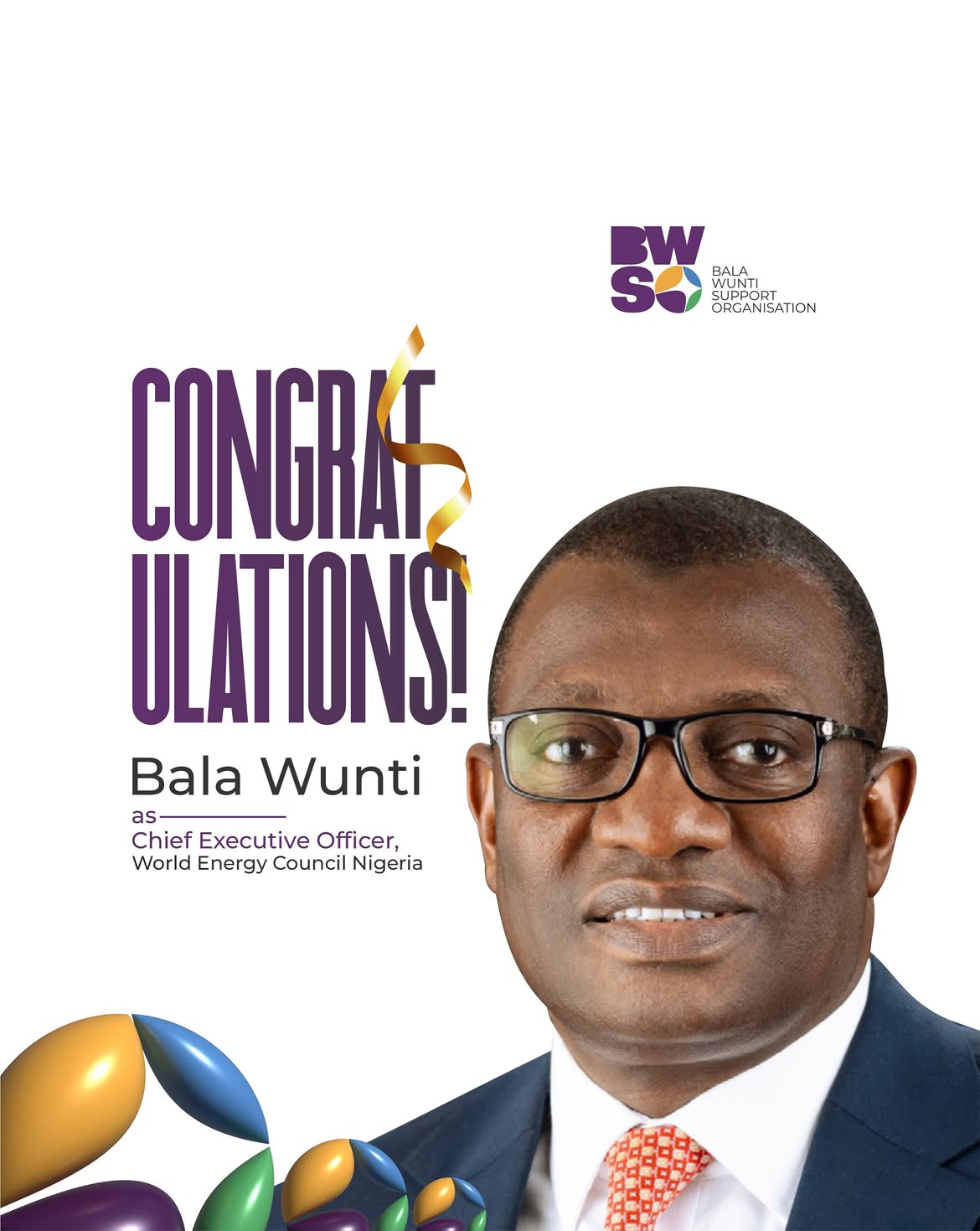
Bala Wunti, formally identified in public sources as Dr. Bala Maijama’a Wunti, is a Nigerian oil and gas technocrat whose professional career spans more than three decades in some of the country’s most strategically important petroleum institutions. His career has taken him from early work in the chemical sector to senior leadership positions within the Nigerian National Petroleum Corporation and, later, NNPC Limited.
Over the years, Wunti has served in technical, commercial, strategic, managerial and executive capacities. He became particularly prominent through his leadership roles at the Petroleum Products Marketing Company (PPMC), National Petroleum Investment Management Services (NAPIMS), and NNPC’s upstream investment structure.
His story has also moved beyond the oil industry. In recent years, Wunti has become increasingly associated with philanthropy, youth development and community initiatives in Bauchi State through the Wunti Al-Khair Foundation. In 2026, he also entered a new chapter of public life after declaring his intention to contest the 2027 Bauchi State governorship election on the platform of the All Progressives Congress (APC).
This Bala Wunti biography examines his background, education, professional journey, major assignments, public impact, philanthropy, political ambitions and the areas where reliable public information remains limited.
Quick Facts About Bala Wunti
| Category | Details |
|---|---|
| Full name | Dr. Bala Maijama’a Wunti |
| Commonly known as | Bala Wunti |
| Year of birth | 1970 is widely reported |
| Exact date of birth | Not independently verified |
| Place of origin | Bauchi State, Nigeria |
| Nationality | Nigerian |
| Secondary education | Government Science School, Toro, Bauchi State |
| University | Ahmadu Bello University, Zaria |
| First degree | Bachelor’s degree in Chemistry |
| Postgraduate education | Abubakar Tafawa Balewa University |
| Executive education | Harvard Business School and University of Oxford programmes are publicly reported |
| Major industry | Oil and gas |
| NNPC career | More than three decades |
| Former MD | Petroleum Products Marketing Company |
| Former GGM | National Petroleum Investment Management Services |
| Former senior role | Chief Upstream Investment Officer, NNPC upstream investment structure |
| Later NNPC role | Chief Health, Safety and Environment Officer |
| Philanthropic organisation | Wunti Al-Khair Foundation |
| Political development | Declared intention to contest 2027 Bauchi governorship election |
| Net worth | No reliable public figure has been verified |
Early Life and Family Background

Bala Wunti was born in 1970, according to multiple biographical and professional sources, and is associated with Bauchi State in northern Nigeria. Some publications describe his roots specifically in Wunti, an area of Bauchi from which his surname is associated.
Public accounts of his childhood often portray his upbringing as modest and challenging. However, details about his parents, siblings and the precise circumstances of his childhood are not consistently documented by authoritative sources.
Some online biographies claim that Wunti lost both parents at a young age and was subsequently raised by relatives. Because this detail is not consistently corroborated by primary or highly authoritative sources, it should be treated cautiously.
As of this writing, there is no publicly verified information confirming the complete names of his parents, the number of his siblings or a comprehensive account of his childhood household.
What is much better documented is the importance of education in Wunti’s early development. His educational journey eventually took him from Bauchi State to Ahmadu Bello University in Zaria and later into advanced management programmes associated with leading international institutions.
Growing Up in Bauchi State
Bauchi has played a significant role in Wunti’s personal identity and public activities. Even after spending much of his professional life working in Nigeria’s major commercial centres, particularly Lagos and Abuja, he has maintained strong links with his home state.
His later philanthropic activities demonstrate this connection. The Wunti Al-Khair Foundation, established in Bauchi, focuses on education, healthcare, economic empowerment and community development.
That connection has also become increasingly important in his public life. His 2026 declaration to seek the APC ticket for the 2027 Bauchi governorship election represents a transition from corporate and philanthropic leadership into direct political participation.
Education and Academic Journey
Education is one of the clearest themes running through Bala Wunti’s biography. His academic background combines science, business and management, an unusual combination that later proved useful in a petroleum industry where technical knowledge and commercial judgment frequently intersect.
Wunti attended Government Science School in Toro, Bauchi State, where he completed his secondary education. Tribune reports that he obtained his West African Senior School Certificate Examination qualification before proceeding to university.
He subsequently gained admission to Ahmadu Bello University, Zaria, reportedly through the IJMB route. At ABU, he studied Chemistry and earned his bachelor’s degree.
His choice of Chemistry was significant because his first professional experiences were connected to chemicals and petrochemicals before his career developed into broader petroleum-sector management.
Postgraduate Education at Abubakar Tafawa Balewa University
After his undergraduate education, Wunti continued his academic development at Abubakar Tafawa Balewa University in Bauchi State.
Public professional profiles report that he obtained postgraduate qualifications from the university, including an MBA in Marketing and a Postgraduate Diploma in Management. These qualifications added commercial and administrative dimensions to his scientific background.
The combination of Chemistry, marketing and management became particularly relevant to his later career. Petroleum-sector leadership requires more than technical knowledge; executives must understand markets, contracts, investment decisions, negotiations, organisational structures and government policy.
Wunti’s subsequent career demonstrates how he moved progressively from technical and commercial responsibilities into corporate strategy and national-level petroleum investment management.
Harvard and Oxford Executive Education
Wunti’s professional education did not end with his Nigerian university qualifications.
Tribune reports that he is an alumnus of Harvard Business School’s Advanced Management Program and the University of Oxford’s Blavatnik School of Government.
These programmes belong to the executive-education stage of his career rather than representing replacements for his original university degrees. They reflect a later effort to strengthen his understanding of leadership, management, public policy and institutional decision-making.
His educational profile therefore spans three major areas: scientific training through Chemistry, commercial training through an MBA in Marketing, and executive and public-sector leadership development through advanced management programmes.
The Beginning of His Professional Career
Before becoming a major figure in Nigeria’s petroleum industry, Wunti gained experience in the private sector.
The Guardian reports that he began his professional journey at Doma Chemicals in Lagos in the early 1990s, where he worked in chemicals import and export. This early position exposed him to commercial transactions, product movement and the realities of operating within Nigeria’s business environment.
The experience was relatively short compared with his later career, but it provided an important bridge between his scientific education and his eventual work in oil, gas and petrochemicals.
By the early 1990s, Nigeria’s petroleum industry offered opportunities for professionals who could combine technical competence with commercial understanding. Wunti’s subsequent move into NNPC would become the defining professional transition of his life.
Joining NNPC and Entering the Petroleum Industry
Wunti joined the Nigerian National Petroleum Corporation in 1994, according to multiple professional profiles and contemporary reports. His first documented NNPC assignment was as a Production Programming Officer at the Eleme Petrochemical Complex in Rivers State.
The position placed him close to the operational side of Nigeria’s petroleum and petrochemical industry. Rather than entering the corporation immediately at an executive level, his career developed through successive technical, commercial and managerial assignments.
This gradual progression became one of the defining features of his professional story. Over approximately three decades, he moved through increasingly senior positions before eventually reaching the top levels of NNPC’s upstream investment and corporate-management structures.
From Production Programming to Market Research
Between 1998 and 2004, Wunti served in market-research roles connected with the Eleme Petrochemical Company. The Valuechain reports that he was Assistant Chief Market Research Officer in the marketing department of the commercial division during this period.
The move from production programming into market research was important because it broadened his understanding of the petroleum value chain. He was no longer dealing solely with technical processes; he was increasingly involved with markets, customers, commercial intelligence and business decisions.
This combination of technical and commercial experience would later become particularly valuable when he took on strategic responsibilities involving petroleum products, liquefied natural gas and upstream investments.
Brass LNG and the Development of Commercial Expertise
In 2004, Wunti moved to Brass LNG Limited, where he became involved in market research and commercial activities.
The Guardian reports that he established the Market Research Unit at Brass LNG and participated in negotiations connected to LNG Sales and Purchase Agreements with investment-grade buyers.
The Brass LNG experience represented another important stage in his development. LNG projects involve large capital commitments, long-term commercial contracts, international counterparties and complex questions around supply and demand.
Working within that environment gave Wunti exposure to the international side of Nigeria’s energy business and helped prepare him for the strategic positions he would later occupy inside NNPC.
Becoming a Strategic Adviser to NNPC Leadership
Wunti’s career eventually moved from technical and commercial assignments into direct advisory work at the highest level of NNPC.
TheCable reported that before becoming General Manager of the Efficiency Department, Wunti served as Senior Technical Adviser to the Group Managing Director. In that capacity, he was involved in the day-to-day operation and administration of the GMD’s office and provided technical and business advice.
The role was significant because it exposed him to the wider institutional problems confronting the national oil corporation.
Instead of focusing on one operational department, he was increasingly involved in issues spanning commercial strategy, organisational performance, stakeholder management and national petroleum policy.
The Efficiency Unit and Corporate Reform
Wunti later became General Manager of NNPC’s Efficiency Unit.
The role placed him at the centre of efforts to improve institutional efficiency and reduce waste. His professional profile has repeatedly associated him with initiatives designed to improve cost control, accountability and performance across the organisation.
This phase of his career established a pattern that would recur in later positions: identifying structural inefficiencies, developing an operational framework and attempting to translate it into measurable improvements.
It also helped build his reputation as a strategist rather than simply a petroleum engineer or technical specialist. His academic background was in Chemistry, but his professional identity had evolved into that of a multidisciplinary oil and gas executive.
Corporate Planning and Strategy
Between 2017 and 2019, Wunti served as Group General Manager of NNPC’s Corporate Planning and Strategy function.
Corporate strategy at a national oil company carries unusually broad responsibilities. Decisions made within such an institution can influence government revenue, petroleum supply, investment flows, international partnerships and the overall direction of the energy industry.
During this stage, Wunti became associated with several major commercial and strategic initiatives, including negotiations relating to LNG, petroleum-sector investments and longstanding contractual issues.
His reputation within the sector increasingly rested on his ability to operate across different parts of the energy value chain.
Managing Director of the Petroleum Products Marketing Company
In 2019, Wunti was appointed Managing Director of the Petroleum Products Marketing Company, commonly known as PPMC.
The appointment placed him at the centre of Nigeria’s downstream petroleum distribution system.
PPMC was responsible for important parts of the petroleum-products supply chain, meaning that its leadership operated in an environment where fuel availability, distribution, imports, logistics, transparency and government policy were all closely connected.
It was during this period that Wunti became widely associated with one of the most discussed initiatives of his career: Operation White.
Operation White and the Fight Against Petroleum Diversion
Operation White was designed as a transparency and monitoring initiative for Nigeria’s petroleum-products distribution system.
Under Wunti’s leadership at PPMC, the initiative involved an 89-member monitoring team drawn from relevant agencies and security organisations. Its purpose was to track petroleum products from importation and movement through distribution while identifying diversion, smuggling, hoarding and other irregularities.
The programme became one of the most recognisable elements of Wunti’s professional legacy.
Reports credited the initiative with helping improve transparency in petroleum distribution and reducing the amount of product being falsely claimed as consumed. However, individual claims about the exact scale of its financial impact vary among secondary sources, so precise monetary figures should not be treated as independently established unless supported by primary documentation.
The broader significance of Operation White was its attempt to use coordinated monitoring and data to address a problem that had repeatedly affected Nigeria’s petroleum supply system.
From Downstream Leadership to NAPIMS
After his tenure at PPMC, Wunti moved into another strategically important part of the petroleum industry.
In 2020, he became Group General Manager of National Petroleum Investment Management Services, known as NAPIMS. The organisation was responsible for managing and supervising significant aspects of the Nigerian government’s interests in upstream oil and gas investments.
This was a major change in responsibility.
At PPMC, his work had centred largely on the downstream petroleum-products system. At NAPIMS, he became involved with upstream investments, joint ventures, production-sharing contracts and relationships with major international oil companies.
The move placed him at the intersection of government interests and some of Nigeria’s largest oil and gas investments.
The Deep Offshore Act and Production-Sharing Contracts
One of the major assignments associated with Wunti’s upstream career was the review and amendment of Nigeria’s 1993 Deep Offshore Act.
Professional profiles and industry publications credit him with participating in efforts intended to improve government returns from deepwater production-sharing arrangements.
He was also involved in the renegotiation of production-sharing contracts after a prolonged period of disagreement and stagnation.
These negotiations were important because production-sharing contracts determine how governments and petroleum companies share production, costs and economic benefits from oil and gas projects.
The work illustrates the type of complex commercial environment in which Wunti spent much of his senior career: negotiations where legal, financial, technical and national-interest considerations all intersect.
Upstream Investment Leadership
Wunti later served as Chief Upstream Investment Officer within NNPC’s upstream investment structure, a role in which he represented the national oil company’s interests in major upstream activities.
NNPC’s own publications identified him in this capacity during major industry engagements in 2024. He participated in discussions involving investment, production growth, asset development and relationships with international oil companies.
In May 2024, for example, NNPC identified Wunti as its Chief Upstream Investment Officer during the signing of a settlement agreement involving ExxonMobil-related assets and the proposed divestment to Seplat Energy Offshore.
His role placed him among the senior officials responsible for negotiating and protecting Nigeria’s interests in major petroleum investments.
Major Upstream Projects and Investment Negotiations
Wunti’s period in upstream leadership coincided with efforts to revive investment and increase crude-oil production.
In June 2024, he represented NNPC at the Final Investment Decision for the Ubeta Field Development Project, a project involving NNPC and TotalEnergies. NNPC reported the project’s FID value at approximately $550 million and described it as an important step in improving the attractiveness of Nigeria’s upstream sector.
He also participated in engagements concerning the conversion of NNPC-Chevron joint-venture assets to terms under the Petroleum Industry Act.
In September 2024, NNPC reported that the partners were targeting 165,000 barrels per day from the relevant assets by the end of that year.
These assignments demonstrate the breadth of Wunti’s responsibilities during his later NNPC career. His work was no longer confined to internal administration; it involved major investment decisions affecting Nigeria’s upstream petroleum sector.
Tackling Crude Oil Theft and Production Challenges
Nigeria’s upstream industry has long faced problems involving crude oil theft, pipeline vandalism, operational disruptions and declining production.
During Wunti’s tenure in upstream investment leadership, NNPC highlighted efforts to develop an industry-wide security architecture based around detecting, deterring, responding to and recovering from threats to petroleum infrastructure.
NNPC reported that Wunti described this four-part approach as “Detect, Deter, Respond and Recover” and linked the broader collaboration to efforts to restore lost production.
His tenure was also associated with institutional improvements within the upstream investment-management structure. Tribune reported that NUIMS achieved ISO 9001:2015 and ISO 22301:2019 certifications and developed a command-and-control centre as part of efforts to address crude theft and sabotage.
The COVID-19 Period and Energy-Sector Resilience
The COVID-19 pandemic created an extraordinary challenge for Nigeria’s petroleum industry.
Oil prices collapsed, global demand weakened and producing countries faced difficult decisions about investment, production and operational continuity. Nigeria’s oil industry, already under pressure from structural challenges, had to navigate the crisis while maintaining essential operations.
Wunti’s leadership responsibilities during this period included managing aspects of Nigeria’s upstream investment interests at a time when commercial uncertainty was exceptionally high.
His supporters later cited the period as evidence of his ability to manage complex institutions during difficult conditions. The strongest independently documented point, however, is that his tenure coincided with a period of significant disruption in the global and Nigerian energy markets.
His Approach to Leadership

The public record surrounding Wunti’s career suggests a leadership style centred on technical knowledge, commercial negotiation, institutional reform and stakeholder management.
He spent much of his career moving between functions rather than remaining confined to one technical discipline. That progression allowed him to understand the petroleum industry from production, marketing, strategy, investment and executive-management perspectives.
His professional profile also emphasises the importance of safety, speed, compliance and efficiency. During his time in upstream leadership, NNPC materials repeatedly presented these principles as part of the operating culture expected from the investment-management organisation.
Leaving NNPC After More Than Three Decades
In 2025, Wunti’s long career inside Nigeria’s national oil company came to an end.
The Guardian reported in June 2025 that he officially exited NNPC after decades of service and participated in a formal handover ceremony at the NNPC Towers in Abuja.
His departure marked the end of a career that had taken him from a relatively junior production-programming position at the Eleme Petrochemical Complex to some of the highest management responsibilities within Nigeria’s national oil institution.
At his farewell, Wunti reflected on his early years at Eleme and described the lessons of discipline, teamwork and resilience that he said shaped his professional journey.
The retirement did not, however, mark the end of his public profile.
Transition From Oil Executive to Public Figure
After leaving NNPC, Wunti’s activities increasingly centred on philanthropy, community development and public affairs.
The Wunti Al-Khair Foundation had already been established in 2020, according to the organisation’s official history. The foundation describes its mission as addressing educational inequality, healthcare access, economic empowerment and community development.
His public profile therefore began to evolve from that of an oil-sector executive into that of a community-focused public figure.
By 2026, this transition had developed into a political ambition.
Bala Wunti and the 2027 Bauchi Governorship Race
In April 2026, Bala Wunti formally declared his intention to contest the 2027 Bauchi State governorship election under the APC.
Channels Television reported that he made the declaration during a visit to APC leadership in Bauchi Local Government Area. The report said he presented the ambition as a response to calls from citizens, stakeholders and supporters and pledged an inclusive administration if elected.
The Nation similarly reported that Wunti described his motivation as a responsibility to address challenges facing young people and protect the future of the next generation.
His political campaign should be distinguished from his established professional record. His career in NNPC and his philanthropic work are matters that can be documented retrospectively, whereas the outcome of his political ambition remains uncertain as of August 2026.
Philanthropy and the Wunti Al-Khair Foundation
One of the most important parts of the modern Bala Wunti biography is his philanthropic work.
The Wunti Al-Khair Foundation states that Wunti founded the organisation in 2020 in response to educational and socioeconomic challenges affecting underserved communities. Its programmes cover education, healthcare, community development and economic empowerment.
Among its programmes are the Bala Wunti Tech Fellowship, Bala Wunti Education Fund, EmpowerHer Initiative, Health Access Support Programme, vocational-skills initiatives and agricultural programmes.
The foundation also operates the Wunti Montessori Academy and supports healthcare initiatives including Albasar Eye Clinic.
Education, Technology and Youth Development
The Bala Wunti Tech Fellowship is one of the foundation’s more recent initiatives.
Its stated purpose is to help develop technology skills and support young people interested in Africa’s growing digital economy. The foundation describes the fellowship as a platform for innovators, builders and future technology leaders.
This area of his philanthropic work is particularly notable because it extends beyond traditional charity. Rather than focusing only on immediate assistance, programmes centred on skills development attempt to improve participants’ ability to generate long-term economic opportunities.
The foundation has also promoted scholarship and education initiatives, reinforcing education as one of the central themes of Wunti’s post-NNPC public activities.
Healthcare and Community Development
Healthcare is another major area associated with the Wunti Al-Khair Foundation.
Its official programme information lists health-access support and the Albasar Eye Clinic among its initiatives. The foundation also identifies community and cultural-development programmes as part of its wider mission.
This emphasis reflects a broader pattern in Wunti’s public activities: combining professional leadership with social interventions in Bauchi and other Nigerian communities.
However, claims about the exact number of beneficiaries or total monetary value of his personal philanthropic contributions should be treated carefully unless supported by audited reports or independently verifiable documentation.
Family and Personal Life
Bala Wunti maintains a relatively private personal life.
Although some biography websites publish claims about his wife, children, parents and other relatives, reliable public sources do not provide enough consistent evidence to construct a detailed family profile without risking the presentation of unverified information as fact.
As of this writing, there is no publicly verified information confirming the full identity of Bala Wunti’s spouse, the number of his children or a complete account of his immediate family.
This is an important distinction in a biography of a public figure. Professional achievements and public activities can be documented through corporate records and credible reporting, while private family information requires a higher standard of verification.
Bala Wunti’s Net Worth
Bala Wunti’s personal net worth has not been reliably disclosed in an authoritative public financial record.
Several Nigerian biography websites have published estimates ranging from millions of dollars, but these figures generally do not provide audited financial statements, asset declarations or other verifiable evidence to substantiate the numbers.
For that reason, this biography does not present a specific net-worth figure as fact.
As of this writing, there is no publicly verified information confirming Bala Wunti’s personal net worth.
His decades of senior executive service undoubtedly place him among experienced and highly accomplished Nigerian energy professionals, but professional seniority alone is not sufficient evidence for calculating personal wealth.
Awards, Honours and Professional Recognition
Wunti has been associated with professional recognition during his career, and some secondary sources list awards and fellowships attributed to him.
However, the public record is inconsistent regarding the full list of awards, their dates and the institutions that conferred them. Some online biographies list professional fellowships and awards without providing sufficient primary documentation.
As a result, only recognitions that can be independently verified through authoritative records should be treated as established facts.
Where such verification is unavailable, the appropriate conclusion is: As of this writing, there is no publicly verified information confirming the specific award or honour.
Current Public Role as of August 2026
As of August 2026, Bala Wunti is best understood as a former senior NNPC executive, philanthropist and emerging political figure.
His corporate career ended in 2025 after more than three decades of service. His public activities subsequently expanded through the Wunti Al-Khair Foundation and his declared ambition to contest the 2027 Bauchi governorship election.
He also returned to the national conversation on petroleum-sector governance in July 2026 when he appeared before a Senate committee reviewing NNPC’s 2023 audited financial statements.
Wunti told the committee that he found no evidence in the statements supporting the widely circulated claim that ₦210 trillion was missing from NNPC accounts. He explained that the figure resulted from combining separate accounting entries involving receivables and accrued expenses.
The Senate committee chairman, Ibrahim Dankwambo, also said the committee had not established that money was missing, while noting that the review was intended to clarify the company’s accounts.
This episode demonstrates that, even after leaving NNPC, Wunti remains connected to national debates concerning the management and interpretation of Nigeria’s petroleum finances.
Career Timeline
| Period | Career milestone |
|---|---|
| 1990–1991 | Worked at Doma Chemicals in Lagos |
| 1994 | Joined NNPC as a Production Programming Officer at Eleme Petrochemical Complex |
| 1998–2004 | Held market-research responsibilities at Eleme Petrochemical Company |
| 2004–2010 | Worked in market research at Brass LNG |
| 2010s | Served in senior advisory and strategic roles within NNPC |
| 2015–2016 | General Manager, Efficiency Unit |
| 2016–2017 | General Manager/Technical Adviser, Downstream |
| 2017–2019 | Group General Manager, Corporate Planning and Strategy |
| 2019–2020 | Managing Director, Petroleum Products Marketing Company |
| 2020 onward | Group General Manager, NAPIMS |
| 2020s | Senior upstream investment leadership roles |
| 2024 | Chief Upstream Investment Officer in NNPC’s upstream investment structure |
| 2025 | Exited NNPC after decades of service |
| 2026 | Declared intention to contest the 2027 Bauchi governorship election |
| July 2026 | Appeared before Senate committee on NNPC audited accounts |
Verified Quotes and Public Statements
One of Wunti’s most notable public statements came during his 2025 retirement from NNPC, when he reflected on his long career and the lessons he learned during his early years at the Eleme Petrochemical Complex. Contemporary reporting captured his description of himself as a young employee who was hopeful and eager to contribute.
In 2026, during his appearance before the Senate committee, Wunti gave a straightforward explanation of the accounting controversy surrounding the ₦210 trillion figure.
His explanation centred on the distinction between receivables and accrued expenses: money owed to a company is not the same accounting category as money a company owes to others.
These statements are consistent with the broader professional image associated with Wunti: a career built around technical detail, commercial analysis and institutional management.
Official Website and Social Media
Wunti has a personal website presenting information about his career, achievements and public activities.
The Wunti Al-Khair Foundation also maintains an official website documenting its programmes and activities.
A public X account using the handle @BalaWunti has been associated with Bala Wunti, but because third-party profile aggregators rather than the X platform itself were available for verification in this research, it is safer to describe the account as publicly associated with him rather than definitively label it as a verified official account.
His LinkedIn profile is also publicly identifiable under the name Bala Wunti, although access to some profile information may require signing in.
What Makes Bala Wunti’s Career Significant?
The significance of Bala Wunti’s career lies less in one individual appointment than in the breadth of responsibilities he accumulated over time.
He moved through virtually every major layer of Nigeria’s petroleum value chain: chemicals and petrochemicals, market research, LNG commercial work, corporate strategy, downstream petroleum distribution and upstream investment management.
That progression gave him an unusually broad perspective on the Nigerian energy industry.
His career also coincided with several major turning points in the sector, including petroleum-market reforms, debates over production-sharing contracts, the Petroleum Industry Act, crude-oil theft, declining production, international divestments and efforts to attract new investment.
The Bigger Story Behind Bala Wunti Biography

A complete Bala Wunti biography is ultimately a story about professional progression.
He did not begin his career as the head of a national petroleum institution. He began with technical and commercial responsibilities, accumulated experience, moved into advisory work, developed strategic expertise and eventually occupied senior executive positions.
His story also illustrates the changing nature of leadership in Nigeria’s petroleum industry. Technical qualifications may provide the foundation, but senior leadership requires negotiation, commercial judgment, policy awareness, institutional management and the ability to work with government and international partners.
After leaving NNPC, his story entered another phase. Philanthropy gave him a platform for community development, while his 2026 political declaration created the possibility of an even broader public role.
Conclusion: The Legacy of Bala Wunti
Bala Wunti’s professional life is closely intertwined with the history of modern Nigeria’s petroleum industry.
From his early years in the chemical and petrochemical sector to more than three decades of service within NNPC and its successor structures, he developed a reputation as a strategist who worked across technical, commercial and executive functions.
His most notable professional chapters include his time at PPMC, where he became associated with Operation White; his leadership of NAPIMS; his involvement in upstream investment negotiations; and his participation in major initiatives involving production growth, petroleum assets and international energy partnerships.
His post-NNPC career has added another dimension. Through the Wunti Al-Khair Foundation, he has pursued initiatives in education, healthcare, technology, skills development and community empowerment.
Then, in 2026, he entered electoral politics by declaring his intention to seek the APC governorship ticket in Bauchi State for the 2027 election.
Whether his next chapter is defined by politics, philanthropy, energy-sector advocacy or a combination of all three remains to be seen.
What can already be established is that Bala Wunti has built a career that stretches from the operational side of Nigeria’s petroleum industry to its highest strategic levels, followed by an increasingly visible commitment to community development and public service.
For a man whose professional journey began with a chemistry degree and an entry-level petroleum-sector position, the scale of that journey is one of the defining facts of the Bala Wunti biography.
Also read: Natasha Akpoti-Uduaghan Biography: The Remarkable Journey from Kogi Roots to Nigeria’s Senate
Frequently Asked Questions About Bala Wunti
Who is Bala Wunti?
Bala Wunti is a Nigerian oil and gas professional from Bauchi State who spent decades working in NNPC and its related structures. He held senior positions including Managing Director of PPMC, Group General Manager of NAPIMS and senior upstream-investment responsibilities.
What is Bala Wunti’s full name?
He is publicly identified as Bala Maijama’a Wunti in professional and biographical materials.
Where is Bala Wunti from?
Bala Wunti is from Bauchi State, Nigeria. His public biography describes him as born and raised in Bauchi.
When did Bala Wunti join NNPC?
Public professional records state that he joined NNPC in 1994 as a Production Programming Officer at the Eleme Petrochemical Complex.
What did Bala Wunti study?
He studied Chemistry at Ahmadu Bello University, Zaria. He later obtained an MBA in Marketing and a Postgraduate Diploma in Management from Abubakar Tafawa Balewa University.
Was Bala Wunti the Managing Director of PPMC?
Yes. He was appointed Managing Director of the Petroleum Products Marketing Company in 2019.
What is Operation White?
Operation White was a petroleum-product monitoring initiative associated with Wunti’s tenure at PPMC. It used a multi-agency monitoring structure to track petroleum products and combat diversion, smuggling and other irregularities.
Was Bala Wunti the head of NAPIMS?
Yes. He served as Group General Manager of National Petroleum Investment Management Services beginning in 2020.
What is Bala Wunti known for in the upstream oil sector?
He is associated with upstream investment management, production-sharing-contract negotiations, deepwater petroleum policy, cost optimisation, gas monetisation and efforts to improve production and security.
Is Bala Wunti a politician?
As of 2026, he is a political aspirant. Channels Television reported in April 2026 that he declared his intention to contest the 2027 Bauchi State governorship election under the APC.
Is Bala Wunti married?
His professional career is well documented, but reliable public sources do not provide sufficient verified information about his spouse and immediate family.
How much is Bala Wunti worth?
There is no reliably verified public figure establishing his personal net worth.
What is the Wunti Al-Khair Foundation?
It is a philanthropic organisation associated with Bala Wunti that focuses on education, healthcare, empowerment and community development.
Does Bala Wunti have a technology programme?
Yes. His foundation runs the Bala Wunti Tech Fellowship, which focuses on technology skills, innovation and youth development.
What is Bala Wunti’s current role?
As of August 2026, he is a former senior NNPC executive and philanthropist who has declared an intention to contest the 2027 Bauchi governorship election.














+ There are no comments
Add yours