






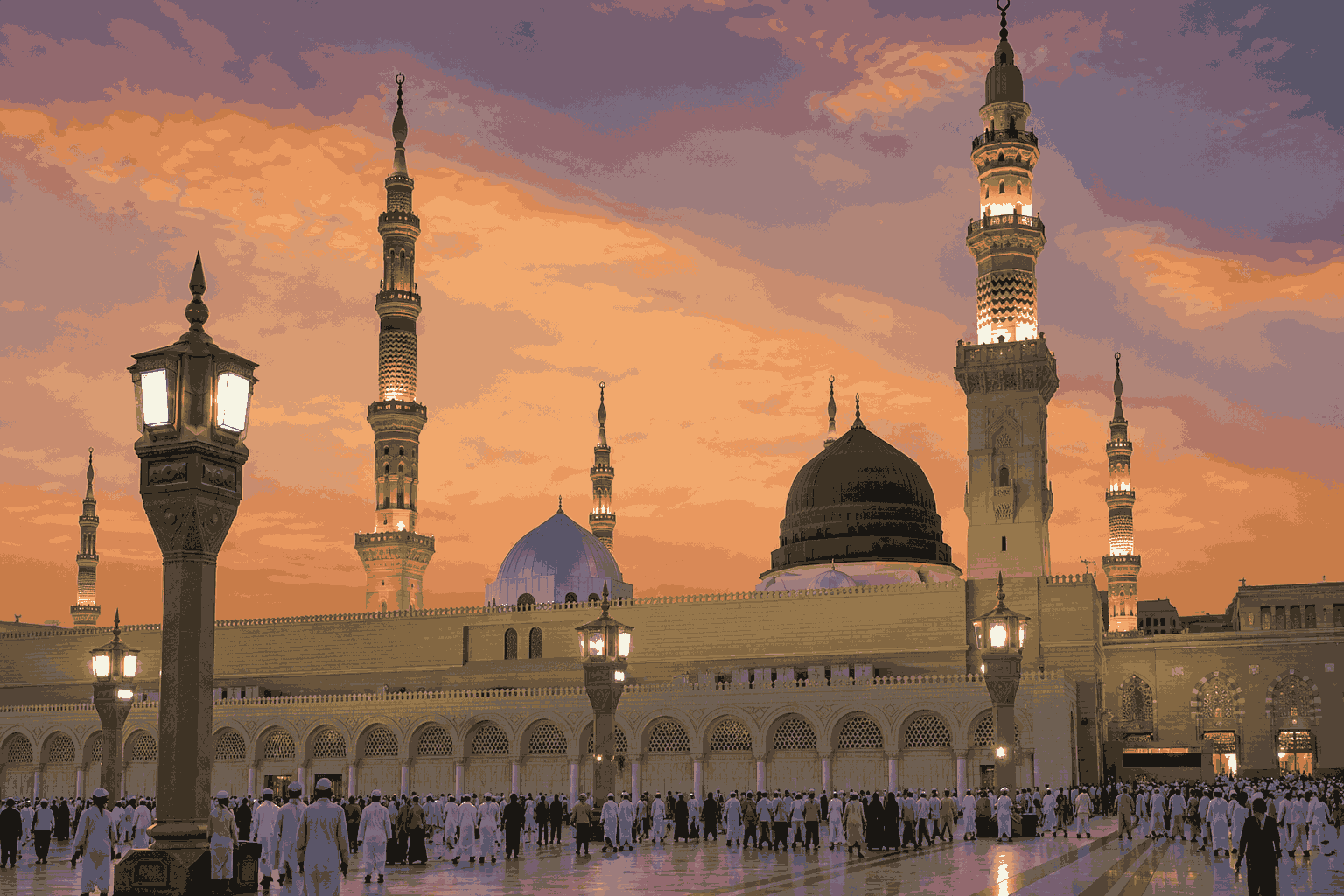
Prophet Muhammad ﷺ is one of the most influential figures in world history. As the final prophet in Islam, he transformed Arabian society and inspired billions of people across generations through his teachings, character, and leadership. His life continues to be studied not only by Muslims but also by historians, scholars, and people interested in religion, ethics, and history.
A comprehensive Prophet Muhammad biography reveals a man known for his honesty, compassion, wisdom, and unwavering commitment to justice long before he received divine revelation. Born in Makkah in the 6th century CE, he overcame personal hardship, social opposition, and political challenges to establish a faith that spread far beyond the Arabian Peninsula.
This article explores his early life, age, tribe, parents, education, citizenship, family background, and the events that shaped him before the beginning of his prophetic mission.
Who Was Prophet Muhammad ﷺ?
Prophet Muhammad ibn Abdullah ﷺ was born around 570 CE in the city of Makkah (Mecca), located in present-day Saudi Arabia. Muslims believe he was chosen by Allah as the final messenger to humanity and that the Qur’an was revealed to him over approximately twenty-three years.
Even before prophethood, he earned widespread respect among the people of Makkah because of his honesty and integrity. He became known as Al-Amin, meaning “the Trustworthy,” and As-Sadiq, meaning “the Truthful.”
His mission centered on:
- Worshipping one God (Allah)
- Justice and equality
- Compassion toward others
- Honesty in business
- Protection of the poor and vulnerable
- Strong family values
- Forgiveness and mercy
These principles became the foundation of Islamic civilization.
Prophet Muhammad’s Age and Basic Information
The following overview summarizes key facts about Prophet Muhammad ﷺ based on authentic Islamic historical sources.
| Information | Details |
|---|---|
| Full Name | Muhammad ibn Abdullah ibn Abdul-Muttalib |
| Common Title | Prophet Muhammad ﷺ |
| Birth | Around 570 CE |
| Birthplace | Makkah (Mecca), Arabia |
| Tribe | Quraysh |
| Clan | Banu Hashim |
| Father | Abdullah ibn Abdul-Muttalib |
| Mother | Aminah bint Wahb |
| Religion | Islam (Final Prophet) |
| Occupation | Merchant, statesman, military leader, prophet |
| Marital Status | Married |
| Wives | Multiple wives during different periods of his life, beginning with Khadijah bint Khuwaylid |
| Children | Seven children (according to traditional Islamic sources) |
| Age at First Revelation | Approximately 40 years |
| Age at Death | Approximately 63 years |
| Place of Death | Madinah (Medina) |
| Burial Place | Madinah |
Prophet Muhammad’s Birth and Family Background
Prophet Muhammad ﷺ was born during a period commonly referred to in Islamic history as the Year of the Elephant, a name associated with an attempted attack on the Kaaba by Abraha, the ruler of Yemen. Traditional Islamic sources connect his birth with this memorable event.
His birth occurred in the respected Banu Hashim clan, one of the leading branches of the powerful Quraysh tribe. Although his family enjoyed honor and noble lineage, they were not among the wealthiest families in Makkah.
The society into which he was born practiced tribal loyalty, idol worship, and often experienced cycles of conflict. Despite these challenges, values such as generosity, courage, hospitality, and keeping one’s word were highly respected. These cultural traits would later complement the moral teachings he preached after receiving revelation.
Prophet Muhammad’s Parents
Father: Abdullah ibn Abdul-Muttalib
Prophet Muhammad’s father, Abdullah, belonged to the Banu Hashim clan. He was admired for his character and came from an honorable family.
Sadly, Abdullah died while returning from a trading journey before Prophet Muhammad ﷺ was born. As a result, Muhammad entered the world as an orphan from his very first day.
Growing up without a father profoundly influenced his empathy toward orphans and vulnerable members of society. Later, the Qur’an repeatedly encouraged believers to protect and care for orphans, reflecting values demonstrated throughout the Prophet’s own life.
Mother: Aminah bint Wahb
His mother, Aminah bint Wahb, belonged to another respected family in Makkah. She cared for Muhammad during his earliest years and was known for her dignity and noble character.
When Muhammad ﷺ was about six years old, Aminah took him on a journey to Yathrib (later known as Madinah) to visit relatives and honor the memory of his late father. On the return journey, she became ill and passed away at a place called Abwa.
At only six years of age, Muhammad experienced the loss of his mother, leaving him an orphan. This early hardship became a defining part of his life and helped shape his deep compassion for those facing loss and hardship.
Prophet Muhammad’s Tribe
Prophet Muhammad ﷺ belonged to the Quraysh tribe, one of the most influential tribes in Arabia. Within Quraysh, he came from the Banu Hashim clan.
The Quraysh held responsibility for the care of the Kaaba and played a central role in trade and leadership within Makkah. Their caravans traveled north and south, connecting Arabia with neighboring regions and creating opportunities for commerce and cultural exchange.
Being born into Quraysh gave Muhammad familiarity with Arabian customs, tribal politics, and commercial life. These experiences later proved valuable when he guided a rapidly growing Muslim community through both spiritual and societal transformation.
Childhood and Guardianship
After the death of his mother, Muhammad ﷺ was cared for by his grandfather, Abdul-Muttalib, who loved him deeply and recognized his exceptional character.
Unfortunately, Abdul-Muttalib also passed away when Muhammad was around eight years old. Responsibility for raising him then passed to his uncle, Abu Talib, who remained a loyal protector throughout much of the Prophet’s life.
Despite financial limitations, Abu Talib provided Muhammad with stability, guidance, and opportunities to learn the family trade.
As a young boy, Muhammad also worked as a shepherd, a role shared by many prophets according to Islamic tradition. Shepherding required patience, responsibility, alertness, and compassion—qualities that later became evident in his leadership.
Prophet Muhammad’s Education
One of the most discussed aspects of the Prophet Muhammad biography is his education.
Historical Islamic sources describe Muhammad ﷺ as ummi, a term traditionally understood to mean that he did not receive formal schooling and was not known for reading or writing before revelation. This has long been regarded by Muslims as significant because the Qur’an’s literary style and depth are seen as evidence that it was a divine revelation rather than a work produced through formal education.
Although he did not attend a formal school, his life demonstrates profound practical knowledge gained through experience. He developed expertise in:
- Trade and commerce
- Conflict resolution
- Tribal customs
- Public speaking
- Negotiation
- Leadership
- Community building
His wisdom, judgment, and moral character earned him respect from friends and opponents alike.
Prophet Muhammad’s Citizenship and Homeland
The modern concept of citizenship did not exist during Prophet Muhammad’s lifetime. Instead, identity was based on family, clan, and tribe.
He was born and raised in Makkah, located in the Hejaz region of Arabia. Historically, it is therefore most accurate to describe his homeland as Makkah in the Arabian Peninsula, rather than assigning a modern nationality.
Makkah was already an important commercial and religious center because of the Kaaba, attracting visitors from across Arabia for trade and pilgrimage.
Growing up in this environment exposed Muhammad ﷺ to diverse cultures, languages, and ideas, preparing him for a mission that would eventually reach people far beyond Arabia.
Early Career as a Merchant
Before receiving revelation, Muhammad ﷺ became a merchant. He accompanied trading caravans and gained a reputation for fairness, honesty, and reliability.
His ethical conduct distinguished him from many traders of his time. He avoided deception, honored agreements, and treated customers with respect. These qualities strengthened his reputation and eventually led to opportunities that would shape the next chapter of his life.
It was through his work as a merchant that he came to the attention of Khadijah bint Khuwaylid, a successful businesswoman in Makkah—a relationship that would become one of the most significant in his life.
Marriage to Khadijah bint Khuwaylid
One of the most significant chapters in the Prophet Muhammad biography is his marriage to Khadijah bint Khuwaylid (RA). Before prophethood, Muhammad ﷺ worked as a merchant and became known throughout Makkah for his honesty and integrity. His reputation earned him the trust of Khadijah, a respected and successful businesswoman who employed him to manage her trade caravans.
Impressed by his character and the reports of his fairness during commercial journeys, Khadijah proposed marriage through her family. At the time of their marriage, Muhammad ﷺ was approximately 25 years old, while Khadijah is traditionally reported to have been around 40 years old, although some historians suggest she may have been younger.
Their marriage became one of mutual love, trust, and respect. It lasted about 25 years until Khadijah’s death, and throughout her lifetime Muhammad ﷺ did not marry anyone else.
Khadijah played a pivotal role in supporting her husband emotionally and financially. She believed in him immediately after the first revelation and remained his greatest source of comfort during the earliest and most difficult years of his mission. Muslims honor her as one of the greatest women in Islamic history.
Prophet Muhammad’s Children
Traditional Islamic sources state that Prophet Muhammad ﷺ had seven children, most of whom were born to Khadijah (RA).
Sons
- Al-Qasim
- Abdullah (also called At-Tayyib or At-Tahir in some narrations)
- Ibrahim, born later to Maria al-Qibtiyya
All of his sons died in infancy or early childhood, a profound personal sorrow that the Prophet endured with patience.
Daughters
- Zaynab
- Ruqayyah
- Umm Kulthum
- Fatimah
Among his daughters, Fatimah (RA) is especially well known. She married Ali ibn Abi Talib (RA) and became the mother of Hasan and Husayn, two of the Prophet’s grandsons who hold an honored place in Islamic history.
Despite the customs of pre-Islamic Arabia, where daughters were often undervalued, Prophet Muhammad ﷺ treated his daughters with exceptional love and respect. He would stand to greet Fatimah when she visited, seat her beside him, and publicly express his affection for her. His example helped transform attitudes toward women and girls within Arabian society.
Family Life and Character at Home
The home of Prophet Muhammad ﷺ was marked by simplicity rather than luxury. Although he was widely respected in Makkah, he did not pursue wealth or status for their own sake. His household reflected humility, generosity, and gratitude.
He assisted with everyday household tasks, mended his own clothing when needed, and treated family members with kindness. Numerous authentic narrations describe him as gentle, patient, and approachable in his home.
His marriage to Khadijah provided emotional stability and mutual support. Their relationship demonstrates values that remain relevant today: trust, communication, loyalty, and compassion.
Life Before Prophethood
Before receiving revelation, Muhammad ﷺ spent many years reflecting on the moral condition of Makkah. Society at that time was characterized by idol worship, tribal conflict, social inequality, exploitation of the poor, and harmful practices such as female infanticide.
Although he participated in community life, he avoided idol worship and immoral behavior. He became increasingly disturbed by injustice and sought opportunities for solitude and contemplation.
One notable example of his commitment to justice before Islam was his participation in Hilf al-Fudul, an alliance formed by several clans in Makkah to protect the rights of the oppressed and ensure fair treatment in commercial disputes. Years later, the Prophet spoke positively about this pact, indicating that justice should be upheld regardless of religious differences.
Retreat to the Cave of Hira
As he approached the age of forty, Muhammad ﷺ frequently withdrew from the busy life of Makkah to spend time in quiet reflection at the Cave of Hira, located on Jabal al-Nur (the Mountain of Light) outside the city.
During these retreats, he devoted himself to contemplation and worship of the One God according to the understanding available to him. He often spent several nights in the cave before returning home.
These periods of reflection prepared him spiritually for the monumental responsibility that lay ahead.
The First Revelation
Around 610 CE, when Muhammad ﷺ was approximately 40 years old, he experienced the event that changed the course of history.
While meditating in the Cave of Hira during the month of Ramadan, the Angel Jibril (Gabriel) appeared to him and commanded:
“Read (or Recite).”
According to authentic Islamic sources, Muhammad replied that he could not read. The command was repeated, and then the opening verses of Surah Al-‘Alaq (Qur’an 96:1–5) were revealed:
“Read in the name of your Lord who created…”
This marked the beginning of the revelation of the Qur’an, which would continue over approximately 23 years.
Deeply shaken by the experience, Muhammad ﷺ returned home and asked Khadijah to cover him. She comforted him and reassured him of his noble character, saying that Allah would never disgrace someone who cared for relatives, helped the poor, honored guests, and stood for justice.
Khadijah then consulted her learned relative, Waraqah ibn Nawfal, who recognized similarities between Muhammad’s experience and the revelations received by earlier prophets.
The Beginning of Islam
Following the first revelation, Prophet Muhammad ﷺ began receiving further verses of the Qur’an. Initially, he shared the message privately with those closest to him.
Among the earliest believers were:
- Khadijah bint Khuwaylid
- Ali ibn Abi Talib
- Zayd ibn Harithah
- Abu Bakr as-Siddiq
These early Muslims accepted the message despite the risks involved.
The central teachings were straightforward yet revolutionary:
- Worship Allah alone.
- Reject idols.
- Speak the truth.
- Care for the poor and vulnerable.
- Treat women with dignity.
- Honor family ties.
- Practice honesty in business.
- Prepare for accountability in the Hereafter.
These principles challenged the religious, social, and economic systems of Makkah, leading to growing opposition from many leaders of the Quraysh.
Early Persecution in Makkah
As the number of Muslims gradually increased, opposition intensified. Many influential members of Quraysh feared that the Prophet’s message would undermine their authority and the religious traditions associated with the Kaaba.
Muslims faced various forms of persecution, including social boycott, physical abuse, economic pressure, and public ridicule. Some of the earliest converts, particularly those from poorer backgrounds or without tribal protection, suffered severe hardship.
Despite these challenges, Prophet Muhammad ﷺ consistently instructed his followers to remain patient and avoid retaliation where possible. His steadfastness during these years became a defining feature of his leadership and inspired his companions to persevere.
Lessons from This Period
The years before and immediately after the first revelation offer enduring lessons:
- Integrity builds trust long before positions of leadership are attained.
- Strong family support can sustain individuals through profound challenges.
- Reflection and contemplation can prepare a person for significant responsibilities.
- Justice, compassion, and honesty remain timeless virtues.
- Patience and perseverance are essential when facing opposition for doing what is right.
The Hijrah (Migration) to Madinah
After more than a decade of preaching in Makkah, the persecution of Muslims became increasingly severe. Many followers of Prophet Muhammad ﷺ endured social boycotts, economic hardship, imprisonment, and physical abuse because of their faith. Despite these challenges, the Prophet continued to call people to worship Allah and to uphold justice, compassion, and moral integrity.
During this difficult period, a group of people from Yathrib—later known as Madinah (Medina)—accepted Islam after meeting the Prophet during the pilgrimage season. They pledged to support him and invited him to their city, where longstanding tribal conflicts had created a desire for a trusted leader who could unite the community.
Muslims gradually migrated to Madinah, leaving behind their homes and possessions in Makkah. This migration, known as the Hijrah, marks one of the most important events in Islamic history. In 622 CE, Prophet Muhammad ﷺ and his close companion Abu Bakr as-Siddiq (RA) also left Makkah after Quraysh leaders plotted to assassinate him.
According to Islamic tradition, the Prophet and Abu Bakr sought refuge in the Cave of Thawr for three days before continuing their journey. Their safe arrival in Madinah marked the beginning of a new chapter for the Muslim community. Because of its significance, the Hijrah became the starting point of the Islamic (Hijri) calendar.
Establishing the First Muslim Community
Upon arriving in Madinah, Prophet Muhammad ﷺ focused on building a united and just society rather than seeking personal power. One of his first actions was the construction of Masjid an-Nabawi (the Prophet’s Mosque), which served not only as a place of worship but also as a center for education, consultation, and community affairs.
He also established a bond of brotherhood between the Muhajirun (the emigrants from Makkah) and the Ansar (the helpers from Madinah). Many families in Madinah voluntarily shared their homes, wealth, and livelihoods with the newcomers, creating a remarkable example of solidarity and generosity.
To govern the diverse population of Madinah, which included Muslims, Jewish tribes, and other groups, the Prophet introduced the Constitution of Madinah. This agreement outlined principles for mutual protection, religious freedom, cooperation, and the peaceful resolution of disputes. Historians often regard it as one of the earliest written constitutional agreements in history.
Leadership and Community Building
Prophet Muhammad ﷺ demonstrated leadership through service, consultation, and fairness. He regularly sought the opinions of his companions on matters affecting the community, showing that consultation (shura) was an essential principle of governance.
He encouraged:
- Justice regardless of social status.
- Fair treatment in business and trade.
- Care for orphans, widows, and the poor.
- Respect for agreements and treaties.
- Kindness toward neighbors.
- Mercy toward children and animals.
His leadership combined spiritual guidance with practical administration, enabling the growing Muslim community to develop stable social and economic institutions.
The Battle of Badr (624 CE)
The first major military confrontation between the Muslims and the Quraysh occurred at Badr, approximately two years after the Hijrah.
The Muslim force numbered around 313 men, while the Quraysh army was significantly larger and better equipped. Despite the numerical disadvantage, the Muslims achieved victory.
For Muslims, the Battle of Badr represented more than a military success. It strengthened the confidence of the community and reinforced their belief that perseverance, discipline, and faith could overcome seemingly overwhelming challenges.
The Qur’an refers to this battle as an important turning point in the early history of Islam.
The Battle of Uhud (625 CE)
The following year, the Quraysh returned seeking revenge, leading to the Battle of Uhud.
Initially, the Muslims gained an advantage. However, during the battle, some archers left their assigned positions despite the Prophet’s instructions, believing the conflict had already been won. This allowed the opposing forces to regroup and launch a counterattack.
Prophet Muhammad ﷺ was injured during the battle, and several prominent companions were martyred, including Hamzah ibn Abdul-Muttalib (RA), the Prophet’s beloved uncle.
Although the Muslims suffered significant losses, the Battle of Uhud became an enduring lesson about discipline, obedience, and perseverance during adversity.
The Battle of the Trench (Battle of Khandaq)
In 627 CE, several hostile tribes formed a coalition to attack Madinah.
Following the advice of Salman al-Farisi (RA), the Muslims adopted an unfamiliar defensive strategy by digging a trench around the exposed parts of the city. This prevented cavalry from launching a direct assault and significantly weakened the attacking coalition.
After enduring difficult weather and internal disagreements, the coalition eventually withdrew without achieving its objectives.
The successful defense of Madinah demonstrated the value of strategic planning, consultation, and cooperation.
The Treaty of Hudaybiyyah
One of the most remarkable examples of the Prophet’s diplomacy occurred in 628 CE.
Prophet Muhammad ﷺ and approximately 1,400 companions traveled toward Makkah intending to perform the pilgrimage (Umrah). The Quraysh prevented them from entering the city, leading to negotiations that resulted in the Treaty of Hudaybiyyah.
Some companions initially viewed certain terms of the agreement as unfavorable. However, the Prophet accepted the treaty because he recognized its long-term benefits.
The agreement established a period of peace, allowing greater interaction between communities. During this time, many people embraced Islam after witnessing the character and conduct of Muslims in peaceful circumstances.
Historians generally consider Hudaybiyyah one of the Prophet’s greatest diplomatic achievements because it created the conditions for rapid growth of the Muslim community.
The Spread of Islam Beyond Arabia
After the Treaty of Hudaybiyyah, Prophet Muhammad ﷺ expanded his efforts to communicate the message of Islam beyond the Arabian Peninsula.
Historical sources describe letters being sent to various rulers and leaders, inviting them to learn about Islam. These included rulers associated with the Byzantine Empire, the Sasanian Empire, Egypt, and Abyssinia.
These diplomatic efforts reflected the universal nature of the Prophet’s message and demonstrated that engagement with other societies could occur through dialogue as well as through local community building.
The Conquest of Makkah (630 CE)
In 630 CE, circumstances led to the breakdown of the Treaty of Hudaybiyyah after one of the allied tribes violated its terms.
Prophet Muhammad ﷺ marched toward Makkah with a large Muslim force. The city surrendered with minimal resistance, avoiding the widespread bloodshed that many had feared.
One of the most memorable aspects of the conquest was the Prophet’s response to those who had persecuted him and his followers for many years.
Rather than seeking revenge, he declared a general amnesty for many of the inhabitants of Makkah, saying in effect that they would not be blamed for the past and were free to go.
He then entered the Kaaba and removed the idols that surrounded it, restoring it to the worship of Allah alone according to Islamic belief.
The Conquest of Makkah marked a decisive turning point in Arabian history and led many tribes to embrace Islam.
Lessons from the Hijrah and Later Years
The events of this period highlight several enduring principles:
- Faith should be accompanied by careful planning and practical action.
- Strong communities are built on justice, cooperation, and mutual respect.
- Diplomacy and peaceful agreements can produce lasting success.
- Forgiveness can achieve what revenge cannot.
- Leadership is demonstrated through humility, consultation, and service to others.
The Farewell Pilgrimage (Hajjat al-Wada’)
In the tenth year after the Hijrah (632 CE), Prophet Muhammad ﷺ performed what became known as the Farewell Pilgrimage. It was the only complete Hajj he performed after the establishment of the Muslim community in Madinah.
More than 100,000 Muslims from across the Arabian Peninsula joined him during this historic pilgrimage. They came to worship Allah and to learn directly from the Prophet how to perform the rites of Hajj.
Throughout the journey, Prophet Muhammad ﷺ carefully demonstrated every ritual, teaching his companions that worship should be performed sincerely and in accordance with divine guidance. He reminded them that these practices were not merely physical acts but expressions of faith, humility, and obedience to Allah.
The Farewell Pilgrimage became the model for how Muslims perform Hajj today.
The Final Sermon
On the 9th of Dhul-Hijjah, at the plain of Arafat, Prophet Muhammad ﷺ delivered one of the most important speeches in history, commonly known as the Farewell Sermon.
In this sermon, he summarized the core principles of Islam and reminded Muslims of their responsibilities toward Allah and one another.
Among the major themes were:
Equality of Humanity
The Prophet declared that all people descend from Adam and Eve and that no Arab has superiority over a non-Arab, nor a non-Arab over an Arab, except through righteousness and good character.
This message challenged the tribal divisions and social prejudices that existed in Arabia.
Protection of Life and Property
He emphasized that the lives, wealth, and honor of every person are sacred and must never be violated unjustly.
This principle laid an ethical foundation for justice and human dignity within Islamic teachings.
Rights of Women
Prophet Muhammad ﷺ reminded men to treat women with kindness, respect, and fairness. He explained that marriage is based on mutual rights and responsibilities and urged husbands to fulfill their obligations with compassion.
His guidance significantly improved the status of women compared with many prevailing customs of pre-Islamic Arabia.
Justice and Honesty
The Prophet instructed Muslims to avoid oppression, dishonesty, exploitation, and injustice.
He reminded believers that everyone would ultimately stand before Allah and be accountable for their deeds.
Holding Firm to Divine Guidance
Near the conclusion of the sermon, he urged Muslims to remain committed to the teachings of Allah and to follow the guidance that had been revealed.
The Farewell Sermon remains one of the most frequently studied speeches in Islamic history because of its emphasis on justice, equality, mercy, and moral responsibility.
Completion of the Religion
During the Farewell Pilgrimage, Muslims believe Allah revealed the following verse from the Qur’an (5:3):
“Today I have perfected your religion for you, completed My favor upon you, and have chosen Islam as your religion.”
This verse is understood by Muslims to signify that the essential teachings of Islam had been completed.
Prophet Muhammad’s Final Days
After returning to Madinah, Prophet Muhammad ﷺ continued teaching, leading prayers, and advising his companions.
A few months later, he became ill. Despite his illness, he remained concerned about the welfare of the Muslim community and encouraged believers to remain united, uphold prayer, and fulfill their responsibilities toward one another.
As his condition worsened, he asked Abu Bakr as-Siddiq (RA) to lead the congregational prayers, a decision that later became significant in the leadership of the Muslim community.
Throughout his illness, he continued to demonstrate patience, gratitude, and trust in Allah.
The Death of Prophet Muhammad ﷺ
Prophet Muhammad ﷺ passed away in 632 CE, at approximately 63 years of age, in the room of his wife Aisha bint Abu Bakr (RA) in Madinah.
His passing deeply saddened the Muslim community. Many companions struggled to accept the news.
Abu Bakr (RA) addressed the people with words that have become famous in Islamic history:
“Whoever worshipped Muhammad, then Muhammad has died. Whoever worships Allah, then Allah is Ever-Living and never dies.”
This reminder reaffirmed that Islam centers on the worship of Allah alone.
Prophet Muhammad ﷺ was buried in the same room where he passed away, which today is located within the area of Al-Masjid an-Nabawi (the Prophet’s Mosque) in Madinah.
Prophet Muhammad’s Legacy
More than fourteen centuries after his death, Prophet Muhammad ﷺ remains one of the most influential figures in human history.
His legacy includes:
The Qur’an
Muslims believe the Qur’an is the final revelation from Allah, preserved exactly as it was revealed.
The Sunnah
His sayings, actions, and approvals—known collectively as the Sunnah—continue to guide Muslims in matters of worship, ethics, family life, business, and social conduct.
Religious Influence
Today, more than 1.9 billion Muslims around the world follow Islam and regard Prophet Muhammad ﷺ as the final messenger of Allah.
His teachings influence daily life in virtually every region of the world.
Social Reform
The Prophet advocated:
- Care for orphans.
- Charity for the poor.
- Justice in trade.
- Compassion toward animals.
- Respect for parents.
- Honesty in speech.
- Mercy toward others.
- Protection of women’s rights.
- Equality before God.
Many historians recognize that these teachings contributed to significant social reforms in seventh-century Arabia.
Was There a Photograph of Prophet Muhammad?
No.
There are no authentic photographs or contemporary portraits of Prophet Muhammad ﷺ because he lived in the 6th and 7th centuries CE, more than a thousand years before photography was invented.
In addition, many Muslim traditions—particularly within Sunni Islam—discourage or prohibit visual depictions of the Prophet out of reverence and to avoid idolatry. As a result, Muslims generally honor him through his teachings and character rather than through images.
Did Prophet Muhammad Have Instagram or Social Media?
No.
Prophet Muhammad ﷺ lived over 1,400 years before the invention of the internet, smartphones, or social media platforms.
Therefore:
- Instagram: None
- Facebook: None
- X (formerly Twitter): None
- TikTok: None
- YouTube: None
Any account claiming to belong to Prophet Muhammad ﷺ is not authentic.
What Was Prophet Muhammad’s Net Worth?
There is no reliable historical record that allows a modern calculation of Prophet Muhammad’s net worth.
Although he worked successfully as a merchant before prophethood, he chose a life of simplicity. Historical accounts describe him giving generously in charity and living modestly, even when resources became available to the Muslim community.
For this reason, assigning a monetary “net worth” would be speculative and historically misleading.
Conclusion
The life of Prophet Muhammad ﷺ is a story of faith, perseverance, compassion, and leadership. Born as an orphan in Makkah, he grew into a trusted merchant, a devoted husband, and ultimately the final prophet in Islam. Through patience, wisdom, and unwavering commitment to justice, he transformed the religious and social landscape of Arabia.
His teachings continue to inspire billions of people around the world. Whether studied from a religious, historical, or ethical perspective, his life offers enduring lessons about honesty, mercy, forgiveness, humility, and service to humanity.
Frequently Asked Questions (FAQs)
1. How old was Prophet Muhammad ﷺ when he received revelation?
Prophet Muhammad ﷺ was approximately 40 years old when the Angel Jibril (Gabriel) brought him the first revelation in the Cave of Hira.
2. Which tribe did Prophet Muhammad ﷺ belong to?
He belonged to the Quraysh tribe, specifically the Banu Hashim clan, one of the most respected families in Makkah.
3. How old was Prophet Muhammad ﷺ when he died?













+ There are no comments
Add yours